


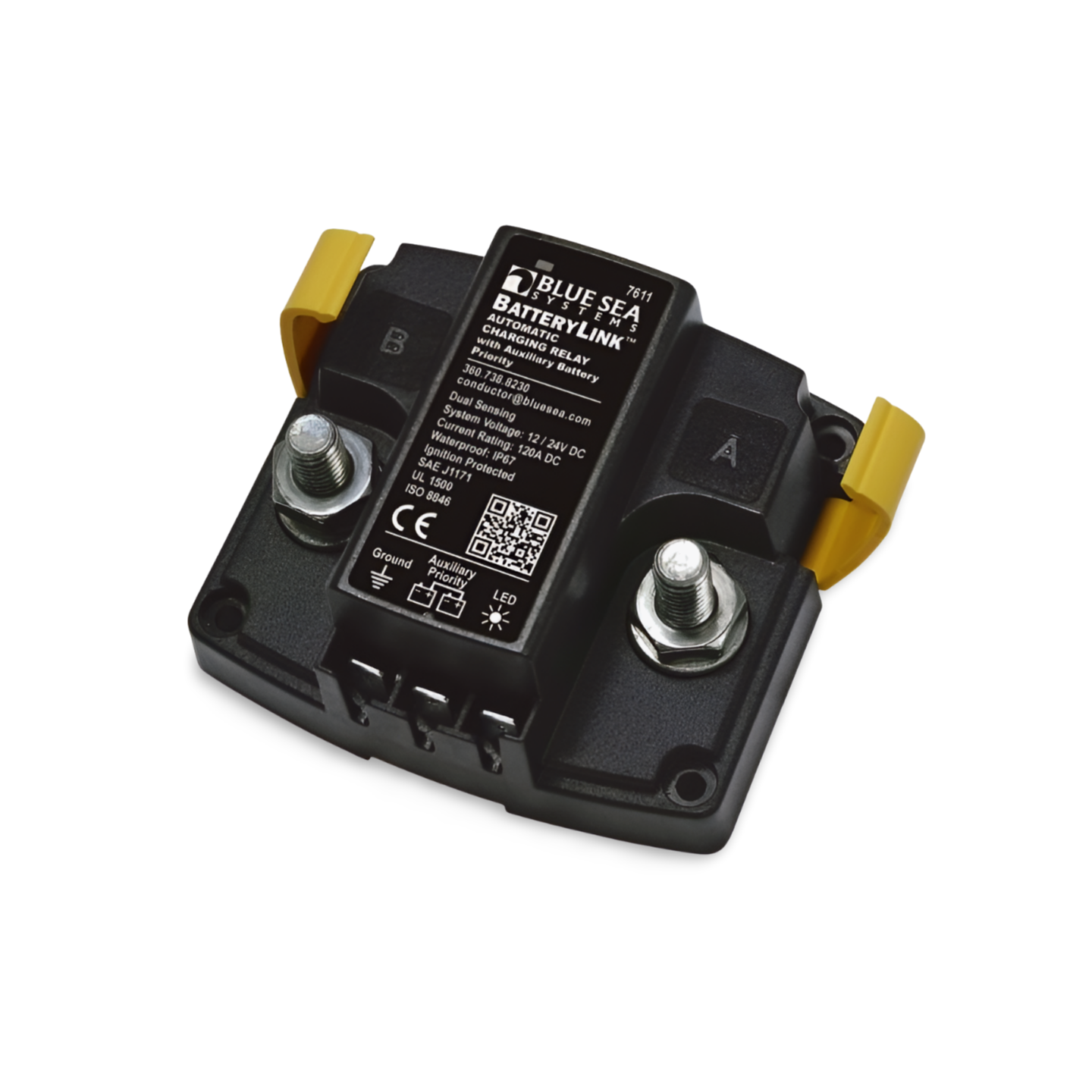

Blue Sea BS 7611 BatteryLink Automatic Charging Relay automatically shares single charging sources with an auxiliary battery.
KEY FEATURES
- 120A continuous power
- Automatic 12/24V DC input voltage
- Charging on two battery banks
- Side and bottom knockouts for cable connections
- Covers insulate terminals
- Stud length: 22mm to accept multiple cable connections
- Integrated LED indicates ACR status
- With an auxiliary battery connection, the auxiliary battery retains its charge longer when the engine handles auxiliary loads for an extended period
- Auxiliary LEDs indicate ACR status (additional LEDs required for this extra)
TECHNICAL DETAILS
- Nominal voltage: 12V DC
24V DC - Auxiliary battery priority: yes (open circuit voltage reduced from 12.75V to 12.25V. Relay remains closed longer, combining batteries to allow auxiliary loads to be used for an extended period)
- Operating voltage: 175mA @ 12V (combined)
115mA @ 24V (combined)
15mA (open) - Continuous charging current: 120A
- Peak charging current: 210A (5 min.)
- Maximum cable size: 1/0 AWG
- Maximum torque: 15.82 Nm
- Terminal stud size: 3/8" - 16 (M10)
-
Relay contact position: Combined 30 sec. 13.6V @ 12V
27.2V @ 24V
Combined 2 Min. 13.0V @ 12V DC
26.0V @ 24V DC
Overvoltage lockout 16.0V @ 12 V
32.0V @ 24 V
Low voltage 12.75V @ 12 V
25.5V @ 24 V - Auxiliary priority: 12.25V @ 12V
24.5V @ 24V - Weight: 0.57 kg
Distinction BS 7610 vs BS 7611:
The main difference is the "Auxiliary Battery Priority" function of the BS 7611.
This function, activated by an additional connection, changes the threshold for disconnecting the batteries:
Standard operation (like 7610): When the charging voltage drops (engine off), the relay disconnects at a battery voltage of approximately 12.75 V to isolate and protect the starter battery as quickly as possible.
With Auxiliary Priority (7611 only): The batteries remain connected until the voltage drops to a lower value (approx. 12.25 V).
Purpose of priority (7611):
This function allows the user to draw on the starter battery's power longer to temporarily operate larger loads on the house battery before disconnection occurs. This is intended for smaller systems that require a little more flexibility. The 7610 does not offer this additional flexibility and strictly adheres to the standard disconnection threshold of 12.75 V.